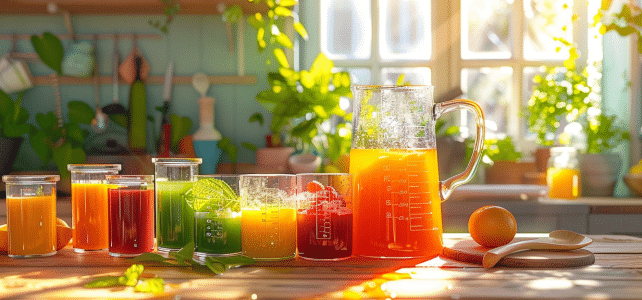
When engaging in cooking, the accuracy of measurements is an essential pillar to ensure the success of recipes. Converting milliliters to centiliters may seem simple, but small conversion errors can lead to culinary disasters. Whether adjusting a recipe to the size of your audience or following instructions from different culinary traditions, a clear understanding of these units of measurement and their relationships is indispensable. Tips and methods to avoid mishaps related to metric conversions are therefore valuable tools for any cooking enthusiast.
The Fundamentals of Volume Conversions in Cooking
Mastering common units of measurement is a prerequisite for any successful conversion. In the field of cooking, milliliters (mL), centiliters (cL), and liters (L) are the preferred units of the decimal metric system, designed for the streamlining and standardization of measurements. One milliliter represents one thousandth of a liter, while one centiliter represents one hundredth. Converting 150 mL to centiliters simply involves dividing this volume by 10, resulting in 15 cL. The reverse operation is equally straightforward: multiply the number of centiliters by 10 to obtain the equivalent in milliliters.
Further reading : How to Easily Find a Qualified Professional Near You
Understanding the equivalences between these units of measurement is fundamental. For equivalence, remember that 1 cL equals 10 mL and that 1 L equals 100 cL. A common mistake is to confuse milliliters and centiliters, leading to incorrect proportions in recipes. Using a measuring cup marked with different units can be helpful to avoid such mix-ups.
In light of the differences between measurement systems, especially when comparing the metric system to the imperial system, caution is essential. One fluid ounce (approximately 28.41 mL) is not equivalent to a centiliter, and a gallon (3.78541 L) should not be confused with a liter. Knowing these approximations helps avoid conversion errors that would have direct repercussions on the quality of the prepared dishes.
Read also : How to Use a Stethoscope?
Whether in the field of cooking, medical dosing, or mixology, measurement precision is synonymous with success. The conversion chart is a valuable tool for confidently navigating between milliliters, centiliters, and other units. Take the time to familiarize yourself with these conversions and integrate them into your daily culinary practice.
Strategies and Tools for Accurate Conversions Without Errors
Conversion errors can be avoided through a good strategy and wise use of available tools. A conversion chart is the most basic and effective tool for accurately converting liquid volumes. These charts provide an overview of the equivalences between units of measurement and allow for error-free transitions from milliliters to centiliters and vice versa. For example, the cl to ml conversion chart will clearly indicate that one centiliter equals ten milliliters, thus facilitating the necessary calculations in cooking recipes or medical dosages.
For common measurements, using tablespoons and measuring cups with precise graduations is recommended. These measuring instruments are often more practical when it comes to small quantities and are generally designed to provide an exact volumetric measurement. Be sure to use them correctly: a tablespoon should not overflow, and a measuring cup should be read at eye level to avoid distortions due to perspective. These tools help significantly reduce the risk of common errors and ensure better consistency in results.
In the field of mixology, where precision is just as fundamental as in cooking or medical dosing, the accuracy of measurements directly influences the quality of cocktails. Specific instruments, such as jiggers or calibrated pour spouts, are used to measure liquid volumes with finesse. For professionals and knowledgeable enthusiasts, these instruments, combined with a thorough understanding of unit conversion, ensure perfectly proportioned drinks. Beyond learning basic equivalences, acquiring proper measurement techniques and using suitable tools is essential to avoid conversion errors in cooking, mixology, and pharmacology.