
Choosing a telescopic hedge trimmer involves considering several technical parameters, the importance of which varies depending on the terrain configuration. Between the motorization, blade length, total weight in extension, and the angle of the cutting head, performance differences between models can sometimes be more pronounced than one might imagine. This article compares these criteria to identify what makes a difference on the ground, including in sloped gardens.
Rotating articulated pole or straight telescopic hedge trimmer: a decisive cutting angle difference
Most guides compare motorizations or brands but overlook a structural point: the geometry of the cutting head. Classic straight telescopic hedge trimmers limit the blade’s inclination to a few fixed positions, often around 90°.
Rotating articulated poles allow for a cutting angle of up to 135° for curved hedges, according to a comparative test published by LSA Conso in March 2025. This differential changes the game for arching hedges, winding borders, or gardens where vegetation follows an irregular relief.
To compare the detailed characteristics of many models, the sheets available on taille-haie-telescopique.com allow for quick cross-referencing of manufacturer data before making a purchase.
Telescopic hedge trimmer on sloped terrain: stability and safety criteria
Trimming a hedge on flat ground and trimming the same hedge on a slope of more than 15% are two distinct exercises. On inclined soil, the user’s center of gravity shifts forward or backward depending on the slope’s direction, and the weight at the end of the pole amplifies this imbalance.
Three technical factors reduce the risk of falling or losing control on sloped terrain:
- The total weight of the device at maximum extension: the higher it is, the greater the tipping torque increases when the pole is oriented up or down the slope. Battery models are generally lighter than gas models, which promotes balance.
- The presence of a carrying harness that distributes the load across the shoulders and torso, not just on the arms. Some manufacturers provide it, while others sell it as a separate accessory.
- The adjustable cutting head without repositioning the body: on a bank, being able to adjust the blade angle from the handle avoids leaning further. Multi-position pivoting head models offer a clear advantage in this configuration.
On a steep slope, it is preferable to work by going up rather than down and to shorten the pole length to keep the tool close to the body. A continuously adjustable telescopic pole (rather than one with fixed notches) facilitates this adjustment.
Comparative analysis of motorizations for telescopic hedge trimmers
The choice between battery, gas, and corded models depends on the area to be covered, the acceptable noise level, and the frequency of use. Since March 2025, European regulations impose a ceiling of 90 dB(A) for new gas hedge trimmers, which reduces the noise gap with electric models but does not eliminate it.
| Criterion | Battery | Gas | Corded |
|---|---|---|---|
| Autonomy | Variable depending on capacity (often 40 to 60 min) | Several hours with a full tank | Unlimited (connected to mains) |
| Average weight | Moderate | Higher | Lightest |
| Noise level | Low | Capped at 90 dB(A) (new 2025) | Low |
| Range | Free | Free | Limited by extension cord |
| Engine maintenance | Minimal | Regular (spark plug, filter) | Minimal |
The French Federation of Landscaping notes in its January 2025 report a significant increase in hybrid battery/gas models since mid-2024. These tools target professionals managing large hedges requiring more autonomy than a single battery can provide, while keeping weight manageable.
Blade length and cutting capacity: adapting the tool to the thickness of the hedge
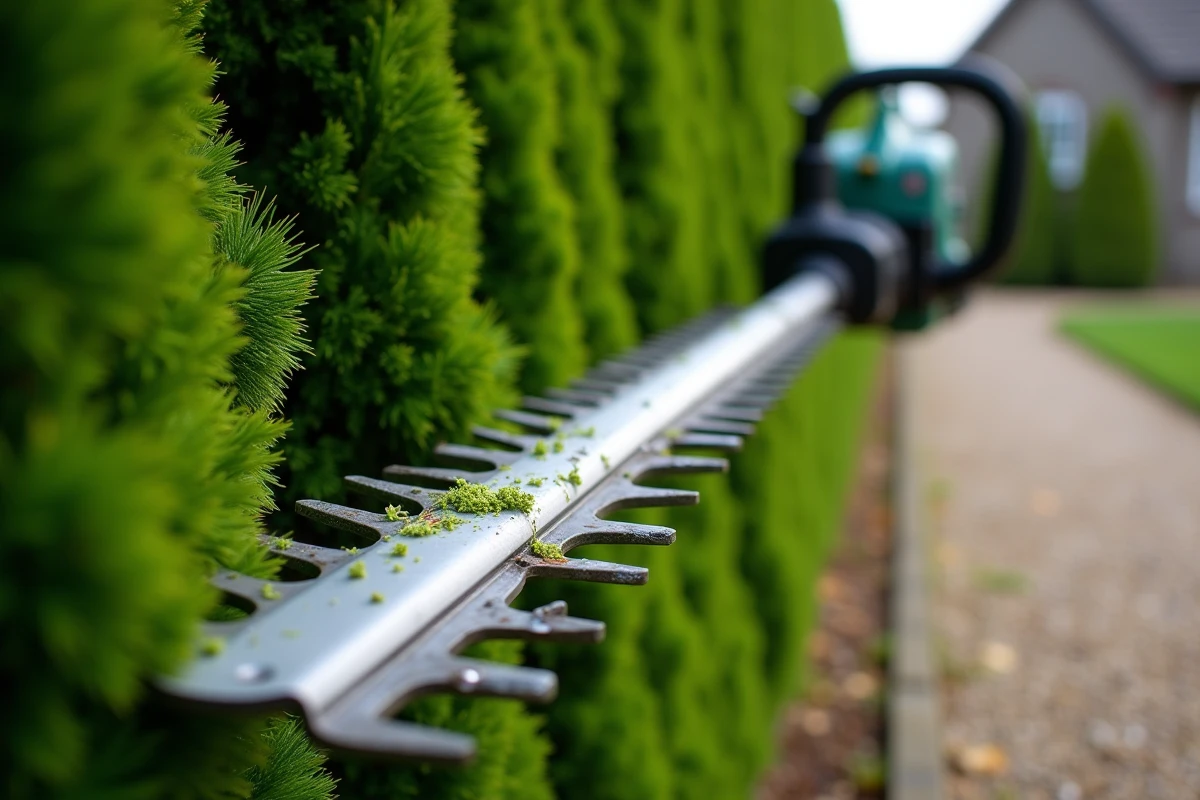
The blade length determines the width of the passage in a single movement. Common models offer blades between 40 and 60 cm. A longer blade speeds up work on a wide hedge but increases the weight at the end of the pole and reduces maneuverability in corners.
The spacing of the blade teeth determines the maximum branch diameter that the tool can cut. For hedges of thuja or laurel with thin branches, a standard spacing is sufficient. For country hedges mixing hardwood species, a wider spacing and a double-action blade (both blades move simultaneously) limit blockages.
On the other hand, a single-action blade (one moving blade) generates more vibrations, which increases fatigue during long sessions. This parameter is particularly significant during use at height or on a slope, where the arms are already under increased strain.
Corrosion of aluminum extensions: an underestimated point of vigilance
Humid and coastal environments
Field feedback indicates a premature wear of aluminum extensions after about 18 months of intensive use in coastal or high-humidity areas. Salt and moisture accelerate the corrosion of telescopic tubes, compromising the locking mechanism.
Before purchasing, checking if the manufacturer offers anti-corrosion treatment or anodized aluminum tubes is part of the useful precautions in these environments. Some brands like Bosch or Einhell specify this point in their technical sheets, while others do not.
Preventive maintenance
A systematic wiping of the pole after each use and the application of a dry lubricant on the sliding parts extend the lifespan of the mechanism. Storing the tool in a ventilated area, with the pole retracted, limits exposure to residual moisture.
The choice of a telescopic hedge trimmer relies less on the brand than on the suitability between the tool’s geometry and that of the terrain. A sloped garden, a thick hedge, or a saline environment radically modifies the appropriate model. Cross-referencing motorization, head angle, weight in extension, and material corrosion resistance remains the most reliable filter before any purchase.